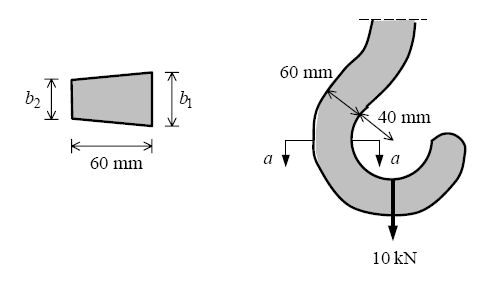
This example shows how to define maximum Von Mises stress for a lifting hook. The load case is illustrated in the figure below. The maximum stress is predicted to be at section a-a. Dimension b1=35mm and b2=25mm.
Create a new study
-
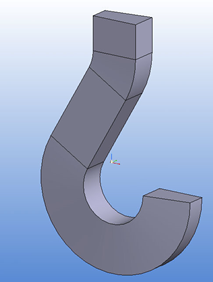
Open model Ex_FEA_Solid_1 from project Examples. Go to FEA state by selecting

-
Create a new study by selecting

-
Fill study information.
Edit element mesh
-
Open FEA Mesh settings dialog by pressing

-
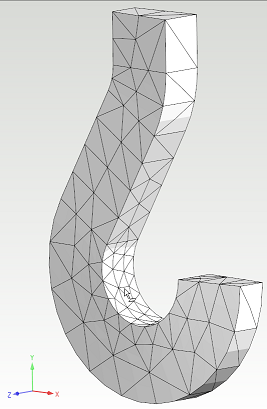
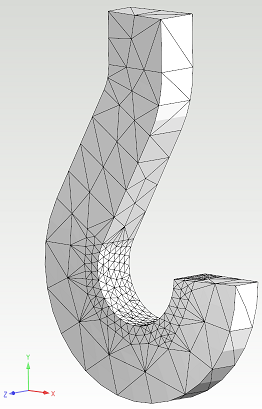
Set 20 degrees as maximum spanning angle for curved surfaces and press Apply. The curved surfaces of hook will be meshed more dense.
-
Refine locally the inner surface of the hook by pressing Target and selecting the surface from 3d model.
-
Set 5mm as target length for element edge. The element mesh is now dense enough on the inner surface of hook where the maximum stresses has been predicted to be.
Set supports and loads
-
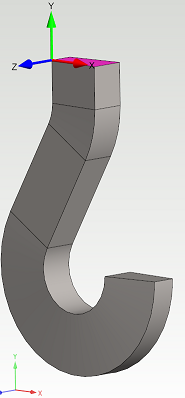
Select the upper end surface of hook. Set the support preset


-
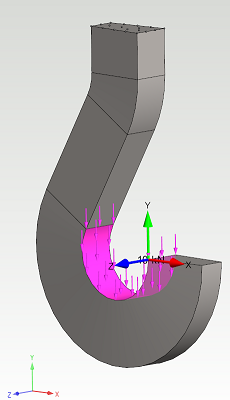
Select the inner surface of hook. Set force of -10 kN in the Y direction.
Solve the study
-
Press

-
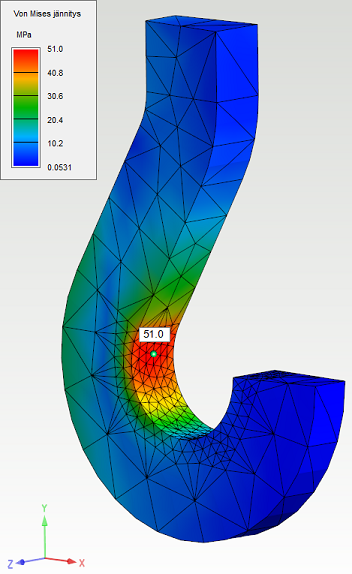
The maximum Von Mises stress for the hook is 51.0 MPa. The location of maximum stress is illustrated in the figure below.